
New Nature Publication Highlights the Importance of White Matter Mapping Across the Lifespan
MINDSET is pleased to recognize important new work recently published in Nature by our research collaborator Kurt G. Schilling and colleagues: “White matter micro- and macrostructure brain charts for the human lifespan.” The study represents a major step forward in the effort to understand how the brain’s white matter develops, matures, and changes with age.
White matter is the brain’s communication infrastructure. It connects regions of the brain into functional networks, allowing information to move efficiently across cortical and subcortical systems. When white matter integrity is disrupted, the effects can be broad and clinically meaningful, with implications for cognition, behavior, neurological disease, and brain injury. The article emphasizes that white matter makes up nearly half of total brain volume and serves as a fundamental conduit for information transfer.
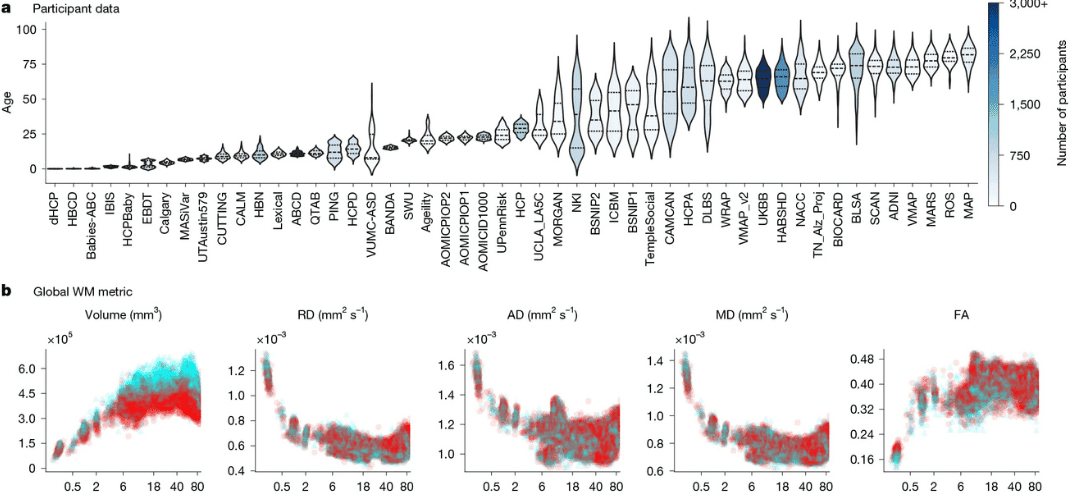
Using diffusion MRI data from 35,120 brain scans across 50 population studies, the authors created lifespan reference charts for white matter microstructure and macrostructure, spanning birth to 100 years of age. These charts include tract-specific measures across 72 anatomically defined white matter pathways, providing a normative framework for understanding how specific brain connections typically change over time.
This is exactly why diffusion tensor imaging and related diffusion MRI methods are so important. Conventional MRI can show many structural abnormalities, but DTI helps characterize the organization and integrity of white matter pathways that may not be fully appreciated on standard imaging alone. For brain injury, where disruption to connectivity may be central to symptoms and functional impairment, the ability to evaluate white matter integrity is critical.
The promise of this work is not that any single scan or metric can answer every clinical question. The authors appropriately note that further validation is needed before these charts can be used as a quantitative diagnostic tool for individual patients. But as a research foundation, this publication moves the field closer to a future where white matter health can be evaluated with greater precision, context, and biological meaning.
For MINDSET, this publication reinforces a core principle of our work: understanding brain integrity requires looking beyond gross anatomy to the networks that make the brain function. DTI provides a powerful window into those networks, and studies like this help advance the scientific foundation for interpreting white matter findings in development, aging, disease, and injury.
For more information please click here.