
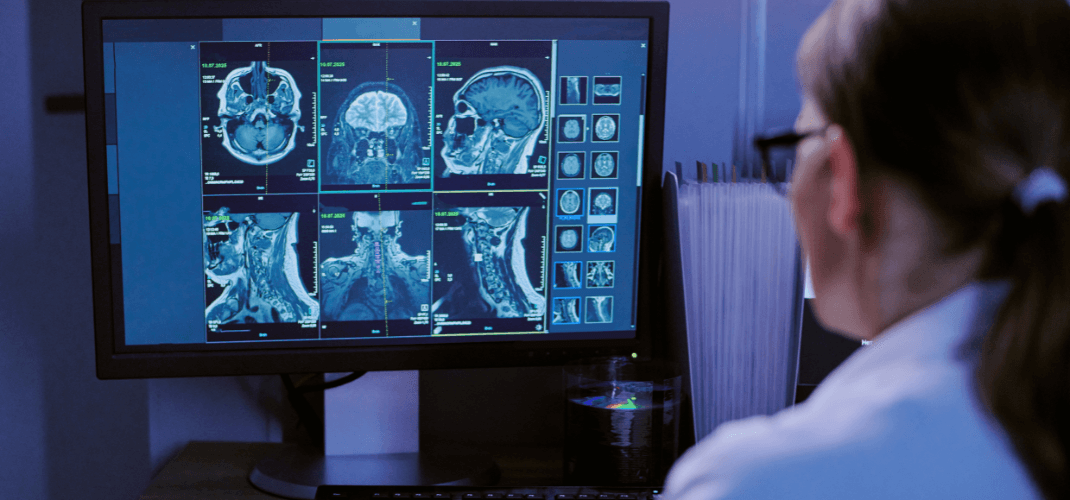
Is DTI Admissible in Court? What the Case Law and Science Show
As Diffusion Tensor Imaging (DTI) has moved from research settings into courtrooms, it has attracted both significant interest and intense scrutiny. Understanding the boundary between "research" and "admissible forensic evidence" is critical for any legal team.
The Limitation of Standard Imaging in mTBI
Conventional CT and MRI are designed to identify acute, gross structural pathology: hemorrhages, fractures, and lesions. They perform this task well. However, they are not optimized to evaluate the integrity of white matter microstructure.
- The Reality: Mild traumatic brain injury (mTBI) often does not produce gross structural changes.
- The Scientific Basis: A "normal" MRI does not rule out microstructural injury; it simply reflects the absence of gross pathology. This is a well-recognized limitation in neuroradiology and the catalyst for more sensitive techniques like DTI.
What DTI Measures (And What It Does Not)
DTI measures the diffusion of water molecules. In organized white matter, water diffuses along axonal fibers—a property quantified by Fractional Anisotropy (FA).
Statistically significant deviations from normative values can indicate a disruption of microstructural integrity. However, DTI findings are not, on their own, diagnostic. They must be interpreted in the context of the full clinical picture, including aging, vascular disease, and pre-existing conditions.
The Legal Standard: Admissibility vs. Weight
Under the Daubert Standard, a trial court's role is to assess the reliability of the methodology, not to decide which expert is more persuasive.
A frequent misunderstanding is the belief that a technique must be independently diagnostic to be admitted. Courts have consistently held that evidence need not establish a fact conclusively to be admissible; it only needs to be relevant and methodologically reliable.
What Methodological Rigor Actually Requires
The courts' analysis of DTI admissibility has converged around four recurring requirements:
Normative Comparison: FA values are only meaningful in relation to a reference population. A rigorous analysis compares individual data against an age-matched normative database.
Protocol Consistency: DTI metrics are sensitive. A defensible methodology requires that the acquisition protocol be appropriate and that the scanner’s relationship to the reference data be documented.
Artifact Identification: Motion or metallic implants can mimic injury. Rigorous methodology requires explicit documentation of how these artifacts were identified and excluded.
Expert Integration: DTI findings must be evaluated alongside documented symptom history, the mechanism of injury, and neuropsychological testing.
The State of the Science and the Law
The admissibility of DTI in any specific case depends heavily on the rigor of the applied methodology and the qualifications of the interpreting expert.
MINDSET’s neuroimaging consultants apply these high methodological standards in every evaluation, ensuring our expert analysis is both scientifically rigorous and legally defensible.